Is WD-40 a degreaser?
WD-40 is a lubricant (fish oil to be exact) dissolved in a solvent. While it can break down grease and oil to a certain degree, it also adds back some. This might be desirable if you are cleaning a hinge, conveyor, or corrosive-prone part, but...
Read This Post
What is the best degreaser?
That depends on the requirements of your application. There are a number of factors that can have a big impact on performance and safety: flammability, dielectric strength, compatibility, toxicity, and environmental impact. Degreasers often...
Read This Post
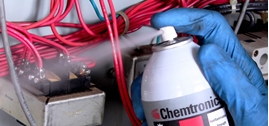
Should I use gloves when using a degreaser?
Yes, it is a good idea to use gloves when degreasing. The solvents used in degreasers do a great job at breaking down greases and oils, which also happen to exist in health skin. If your hands are exposed to a degreasing solvent for enough time,...
Read This Post
Are degreasers toxic?
There are no degreasers that should be taken internally, but some ingredients are more harmful than others. N-Propyl Bromide (nPB), Trichloroethylene (TCE) and Perchloroethylene (Perc) are highly toxic chemicals commonly used in degreasers to...
Read This Post
Do I need to shut off power before cleaning electrical equipment?
Before you start spraying, shut down power to avoid the potential of sparks, electrical shorts or discharges, and other safety hazards. If disconnecting the power is not an option, look for degreasers with a dielectric strength above 30 kV (30,000...
Read This Post
What is degreaser used for?
A degreaser is a cleaner designed to remove grease, oils, cutting fluids, corrosion inhibitors, handling soils, finger prints, and other contamination common in assembly, stamping, other types of metal fabrication, refineries, motor repair,...
Read This Post
How do I avoid peelable solder mask from breaking off and leaving residue behind?
The follow are factor to consider when trying to avoid breakage: 1) Curing – Partially cured mask will have more of a tendency to break or leave residue. 2) Temperature and duration in extreme heat – Mask is designed for wave soldering,...
Read This Post
Why is there white residue when I clean my PCB?
White residue is generally a symptom of ineffective PCB cleaning. Common conductive flux residues from the soldering process can include various unreacted activators, binders, rheology components, and saponifiers. Among these are numerous iterations...
Read This Post
Do you need to clean flux?
Yes, flux should be cleaned off of a printed circuit board (PCB) after soldering is completed. The following are the reasons to remove flux residues: Improve Aesthetic Appearance of PCB - If you are a contract manufacturer of PCB’s, the...
Read This Post
How do you clean excess flux?
The most common way to clean flux residues from a repair area is to saturate a cotton or foam swab with isopropyl alcohol or another cleaning solvent, and rub it around the repair area. While this may be adequate for no-clean flux, where the...
Read This Post