Nothing Performs Like Chemtronics

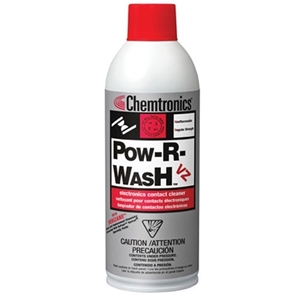
Pow-R-Wash VZ

Pow-R-Wash™ VZ electronic contact cleaner is a highly effective nonflammable solvent cleaner for electrical and electronic contacts and assemblies. The non-ozone depleting solvent system quickly remove oils, oxides, and other contaminants from metal contacts. Pow-R-Wash VZ Contact Cleaner is specially engineered to restore and improve electrical continuity on energized equipment.

VERIZANE™ Cleaning Chemistry (VZ) -  Engineered to replace HCFC-141b, these low odor, no flash, nonflammable aerosols offer the most cleaning value for your money.

So ditch the dirt — without blowing your budget!

New improved formula with lower global warming. (click link for more info)

CLICK HERE FOR CONTACT CLEANER SELECTION GUIDE

Features & Benefits

  • Nonflammable
  • Dielectric Breakdown 15 kV
  • Noncorrosive
  • Evaporates quickly without leaving residue
  • Ideal AK225 replacement

Applications

  • All repair and maintenance contact cleaning
  • Cleaning of metal contacts, plugs and sockets, solenoids
  • Removing oxidized soils from switches, circuit breakers, motors and armatures

Swipe to View Add to Cart Button 

Part # Size
ES6300EA

12 oz / 340 g aerosol

Contact us for further details

FAQ's

Can brake cleaner or carb cleaner be used to clean electrical contacts?

Automotive cleaners like brake and carb cleaners are not ideal for cleaning contacts. Generally speaking, they are often very toxic, harsh on sensitive plastics and gasketing materials common in electronical devices, and are very flammable.

How can you reduce chemical exposure?

Every organization using hazardous chemicals within their facility has the responsibility to equip their facility and personnel to maintain exposure levels below the TLV. Personal monitoring badges can be used to measure exposure of a specific material. Then, depending on the threshold limit and the application, exposure can be controlled with PPE like masks, face shields, respirators, and even coveralls. If they don’t reduce exposure below the recommended limit, you will need to consider a special ventilation hood or even containment booth. As you can see, as the exposure limit gets down to a certain level, the equipment required to safely use the solvent can get impractical. At that point, your best option is to consider a safer alternative.

How do you know the safe exposure limit of a degreaser, contact cleaner, or flux remover?

The personal hazard associated with a solvent is often defined using Threshold Limit Value (TLV), which is the recommended average exposure in an 8-hour day, 40 hour work week. The lower the TLV of a particular substance, the less a worker can be exposed to without harmful effects. TLV is stated on the SDS of chemical products, in additional to recommended personal protection equipment (or PPE). The threshold limit value of a solvent is generally set by the American Conference of Governmental Industrial Hygienists (ACGIH). The unit of measure is Parts Per Million (PPM). 

How do you use an aerosol cleaner?

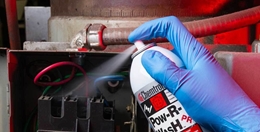
Hold object to be cleaned in vertical position. Pull trigger gently to control solvent flow rate. Scrub with brush from top to bottom, allowing the liquid to flush away contaminants. 

How do I properly dispose of an aerosol can after it is empty?

It may be different state-by-state, so contact your state environmental agency for regional specific regulations. For a general guideline, here is the process according to EPA hazardous waste regulations 40CFR. The can has to be brought to or approach atmospheric pressure to render the can empty. Puncturing is not required, only that it “approach atmospheric pressure”, i.e. empty the can contents until it’s no longer pressurized. This insures that as much contents as is reasonably possible are out of the can. It is then considered “RCRA-empty”. At that point it can be handled as any other waste metal container, generally as scrap metal under the recycling rules. Note that the can is still considered a solid waste at this point (not necessarily hazardous waste).

Is there something I can do with the extension tube (straw) so it doesn’t get lost?

The red cap on Chemtronics aerosol products like flux removers, degreasers, and Freeze-It Freeze Spray has a notch on the top. That is engineered for the straw to snap in and hold into place so you don’t loose it. The aerosol trigger sprayers that are common on dusters, freeze sprays, and flux removers, have two ways to store the straw when not in use. The hole at the back of the body of the sprayer is just the right size for the straw to slide into place for storage. The slot below the trigger is also the right size for the straw to snap into place, which also has the advantage of locking the trigger.

How do I figure out the shelf life of a product?

The shelf life of a product can be found on either the technical data sheet (TDS), available on the product page, or by looking on the certificate on conformance (COC). The COC can be downloaded by going to https://www.chemtronics.com/coc. Once you have the shelf life, you will need to add it to the manufacture date for a use-by date. The manufacture date can be identified by the batch number. The batch code used on most of our products are manufacture dates in the Julian Date format. The format is YYDDD, where YY = year, DDD = day. For example, 19200 translates to the 200th day of 2019, or July 19, 2019. This webpage explains and provides charts to help interpret our batch numbers: https://www.chemtronics.com/batch-codes.

Articles

4 Toxic Chemicals Hiding in Your Company's Contact Cleaners and Degreasers

In industrial applications, toxic chemicals are commonly used in contact cleaners, electrical contact cleaners, degreasers, and ultrasonic cleaners. The chemicals are preferred over non-toxic alternatives because they are nonflammable, have high solvency, and are relatively inexpensive. The four c...
Read This Post

Guide to Defibrillator Maintenance

Defibrillators are medical devices that help revive a patient. It releases a large electric shock to bring back the normal rhythm of the heart. It is commonly used on any patient suffering from sudden cardiac arrest. There are two types of defibrillators, the automatic external defibrillator (AED),...
Read This Post

Regulatory Pressures on “Forever Chemicals” & Viable Alternatives

About 70 years ago, a new class of chemicals were invented that improved everyday products used at home and outdoors, but in time we learned they can be bad for us and can last nearly forever. PFAS (perfluoroalkyl and polyfluoroalkyl substances), also known as “Forever Chemicals”, i...
Read This Post
Ultimate Guide to Contact Cleaners

You're getting intermittent issues with your device, so you suspect there's contamination in the electrical contacts. Dust, dirt, grease, and oxidation contamination can increase electrical resistance in contact areas. That means the current flow is potentially reduced or interrupted, affecting th...
Read This Post
You did not finish submitting your information to request a sample